
Reviewed · HIKING & TREKKING
Mount Ijen Crater Trekking Tour from Bali
Blue flames sound like a trick of light. Here’s the real deal: an overnight trek to Mt Ijen where you hike in the dark for the chance to see blue fire and then get proper views inside the crater. I really like the way the schedule is built around the best timing for the spectacle, and I also like the hands-on human side of the trip, including meeting sulphur miners working the crater. The catch: this is a tough overnight hike plus a long Bali-to-Java transfer, so it isn’t a casual outing.
You start with hotel pickup late in the afternoon (the tour’s start time is 5:00 pm), then cross by ferry from West Bali to East Java. You’ll reach the trail area around midnight, get a safety briefing, and receive equipment like a flashlight and a gas mask before the predawn push. I like that the plan keeps you moving toward the experience instead of wasting hours sitting around.
Because Mt Ijen can be harsh, the tour comes with real expectations: strong fitness, long pants/sports shoes, warmer layers, gloves, and a hat. I also appreciate that the rules are taken seriously, including limits like staying within 500 meters of the crater area and avoiding anything that creates extra fire risk. A good consideration before you go: if you have heart issues, asthma, or other serious medical conditions, this is not recommended.
In This Review
- Key things that make this Mt Ijen tour click
- Why Mt Ijen’s blue fire is a night trek worth the effort
- The Bali-to-East Java ferry route (and why it feels long)
- The predawn hike: short distance, serious effort
- Meeting sulphur miners up close (and how heavy work shapes the crater)
- Summit breakfast and crater viewpoints that actually help your photos
- Descent, fumes, and the crater rules you must follow
- Price and logistics: what $153.85 really covers
- Who should book this Mt Ijen overnight trek
- Weather and the schedule details you shouldn’t ignore
- Should you book this Mt Ijen overnight tour from Bali?
- FAQ
- What time does hotel pickup start for this Mt Ijen tour?
- How long is the tour from Bali to Mt Ijen and back?
- What’s included in the price?
- What should I bring for the blue fire trek?
- Who is this tour not recommended for?
- Is the tour refundable if weather cancels it?
Key things that make this Mt Ijen tour click
- Blue fire is time-sensitive and weather-dependent: you’re going in the dark before dawn.
- You get a small-group experience (max 10 travelers) with local guidance and safety focus.
- Sulphur miners’ work is front-and-center: you’ll see them carry heavy blocks (60–80 kg) and mine with traditional tools.
- You’ll hike a short distance but with steep effort: about 3 km, often 1–2 hours uphill/flat before sunrise.
- Crater rules are strict: stay within the allowed zone and follow bans like no smoking and no littering.
Why Mt Ijen’s blue fire is a night trek worth the effort
Mt Ijen is famous for a rare glow near the crater—often described as blue flames. In practical terms, you’re chasing a glow that depends on conditions and the way the light interacts with the environment. The tour’s biggest value is that it doesn’t try to squeeze the crater into a lazy daytime visit. Instead, you’re positioned for that predawn window, when the crater scene feels most dramatic.
What I like about the way this tour handles the experience is the two-stage viewing. First, you’re guided to the summit area before dawn for the chance to see the blue fire. Then, after you’ve had a light breakfast up on the mountain, you’ll descend and get additional photo opportunities from the crater viewpoint. So even if the blue fire is faint on your date, you still end up with real crater scenery and a clearer sense of what you’re looking at.
This is also one of the few volcanic experiences that connects the spectacle to everyday labor. You don’t just watch a sunrise. You’ll meet sulphur miners who work the crater long hours, using traditional methods and carrying massive loads. It turns the trip into something more meaningful than a checklist moment.
More Bali treks and volcano walks
The Bali-to-East Java ferry route (and why it feels long)
Let’s be honest: the road time is part of the deal. Pickup is from selected hotels in South Bali like Kuta, Legian, Seminyak, Jimbaran, and Nusa Dua, and the tour starts at 5:00 pm. You transfer to Gilimanuk Harbor in West Bali, then cross by ferry to East Java.
You arrive around midnight, then get driven to the mountain starting point. That means you’re spending a lot of the night in transit before the real hiking starts. If you hate late starts, limited sleep, or long stretches with little control over timing, this is where your expectations need to be realistic.
One more small logistics reality: with a small-group setup, departures can include short waiting time while the group assembles. That’s not unusual for this type of overnight operation, but it does mean the evening schedule may not feel perfectly smooth from door to trailhead.
Still, I see this as value: the ferry approach is what makes it possible to do a true overnight plan from Bali. You’re paying for the whole machine: transport, guides, safety gear, and the timing that gets you to the crater window.
The predawn hike: short distance, serious effort
The trek itself is described as roughly 1-mile / 3-km to the summit area, usually taking about 1 to 2 hours. That sounds compact on paper, but the key word here is terrain plus altitude plus night conditions. You’re moving uphill at times, and you’ll be dealing with cold-to-chilly air and fatigue after a long day.
Before you start, you’ll get a safety briefing and equipment, including a flashlight and a gas mask. That matters because Mt Ijen is not a casual walking track. You’ll want to be comfortable using your gear and following your guide’s pace.
What you should plan for:
- Pacing over speed: the climb feels harder when you sprint early and run out of energy.
- Cold layers: the tour explicitly recommends long pants, a sweater/jumper, gloves, and a hat.
- Footing: sport shoes or hiking shoes help you stay stable on uneven ground.
Fitness level is a real screening factor. The tour recommends strong physical fitness, and it’s not recommended for people with heart complaints or asthma. I’d treat that guidance as you reading the weather forecast for your body: don’t gamble with your health.
- Nusa Penida day trip: boat, 4 snorkeling, Manta rays & Land tour★ 5.0 · 2,033 reviews
- Bali Nusa Penida West Private All-Inclusive Tour★ 5.0 · 1,277 reviews
- Mount Batur Sunrise Trekking Private Tour with Breakfast and Hotel Transfer★ 5.0 · 885 reviews
- Individual Bali Day Trip with Private Driver and Free WiFi★ 5.0 · 755 reviews
- Waterbom Bali Tickets – Single Day Pass★ 4.5 · 620 reviews
Meeting sulphur miners up close (and how heavy work shapes the crater)
One of the most striking parts of this tour happens en route. You’ll interact with sulphur miners who carry sulphur blocks using bamboo pole basket systems across their shoulders. The loads mentioned are huge—about 60–80 kg per block.
You’ll also witness how mining works at the crater. The description notes that traditional methods may use iron rods, and it highlights that miners can be working without safety equipment. That’s not a reason to feel alarmed as a spectator—it’s a reason to understand the environment is active, demanding, and not built for tourists.
For you, this is where good tour behavior matters:
- Stay with your guide and stay aware of working areas.
- Don’t block passage.
- If you take photos, keep your distance and don’t crowd the miners.
I like that this tour makes room for the human reality rather than turning the miners into scenery. Seeing the weight and effort makes the blue fire feel less like a gimmick and more like the visible tip of a much bigger industrial landscape.
Summit breakfast and crater viewpoints that actually help your photos
After reaching the summit area before dawn, you’ll have a light breakfast on the mountain. The timing is important: you’re fueling after the hardest part, before you tackle the descent and crater viewing.
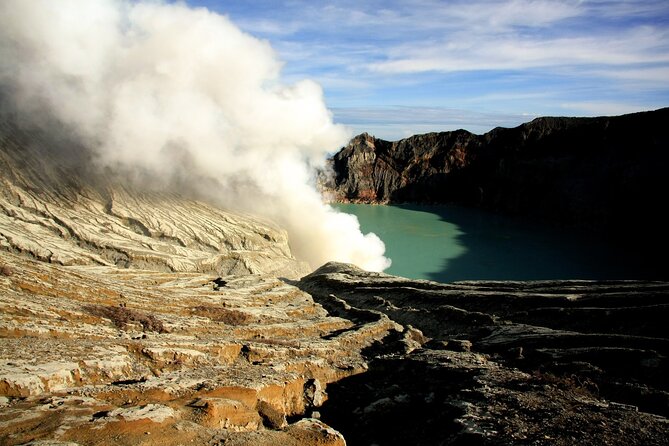
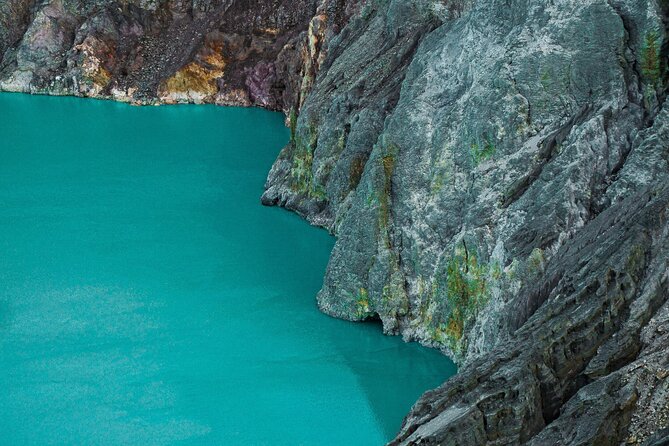
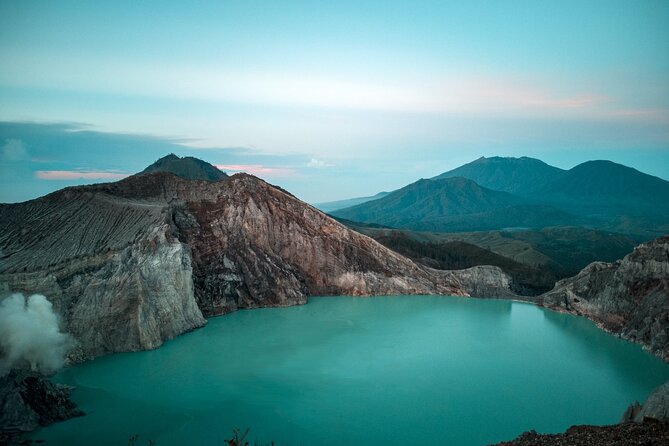
Then the tour shifts into a better photography phase. You’ll have guided photo opportunities of Ijen Crater, including viewpoints that give you a clearer sense of the scale. The crater is described as the largest acid lake in Java, and you can feel that scale when you’re standing where the air, fumes, and steep dropoffs all come together.
Weather still plays a role here. The visibility of blue fire depends on conditions, and clouds can change what the crater looks like even if you arrive at the right time. But the crater itself is dramatic in daylight-adjacent light, which is why the second viewing window is smart.
Also remember the practical reality: your cameras and phones will be cold in the early hours. Gloves help, and you’ll want a plan for quickly swapping lenses or camera settings without fumbling.
Descent, fumes, and the crater rules you must follow
The descent is often the part that surprises people. It’s not just about getting down—it’s about staying safe while the ground changes and the crater environment is still active. The tour notes the need for stamina and healthy condition, and it explicitly warns this is not suitable for children and older participants.
The tour also comes with specific Ijen crater rules. Key ones you’ll want to know before you go:
- Stay within 500 meters of the crater area.
- Sport wear and hiking shoes are expected.
- You must wear the mask (and you’ll receive a gas mask as equipment).
- No throwing rubbish, no smoking, and no making fireplace or throwing anything that could start fire.
- Bring your own medicine.
This matters because the tour is operating in a real site with real hazards. Following the rules isn’t just etiquette; it’s how the group stays within the boundaries that protect everyone.
If you’re the kind of person who hates constraints, this might be where the experience stops being fun. You’ll need to treat your guide’s instructions like the safety rail on a steep stairway.
Price and logistics: what $153.85 really covers
At around $153.85 per person, the price sounds steep until you break down what you’re getting. You’re paying for:
- Hotel pickup and drop-off in South Bali
- Ferry crossing from West Bali to East Java and back
- A driver/guide transfer from Bali to Banyuwangi
- A local guide for the blue fire trekking
- Light breakfast and lunch
- All taxes, fees, and handling charges
What you don’t get: drinks and dinner. So budgeting matters. Bring water if allowed by your comfort level during the hike, and plan on spending for dinner on the Bali side.
Is it good value? For me, the value comes from the overnight timing and the fact that you’re not simply walking—it’s a structured experience with safety gear, a local guide, and the ability to reach the predawn window. If you were to DIY this transfer and guide support, you’d likely lose the efficiency and risk adding confusion late at night.
The small-group cap (max 10) also affects value. You’re less likely to feel swallowed by a huge crowd, which helps when the hike is demanding.
Who should book this Mt Ijen overnight trek
This tour is best if you:
- Can handle an overnight schedule with limited rest before the hike.
- Have decent stamina and feel comfortable on steep, uneven terrain.
- Want a guided experience that includes a look at real working miners, not just views.
- Care about seeing the crater at the right time for blue fire chances.
It’s not a good fit if you:
- Have heart complaints, asthma, or serious medical conditions.
- Are looking for a gentle walk or a relaxed itinerary.
- Are traveling with kids; the minimum age is 16, and it’s not recommended for children aged 15 and under. The tour also notes it’s not suitable for older participants.
- Hate cold and early mornings. You’ll be out before dawn, dressed for the hike.
If you’re a photographer, the plan has built-in opportunities: summit timing plus a closer look on the descent and crater viewpoints. That’s a better photo strategy than just arriving at sunrise and hoping for the best.
Weather and the schedule details you shouldn’t ignore
Mt Ijen is subject to conditions, and your tour can be affected. If it’s canceled due to poor weather, you’ll be offered a different date or a full refund. That’s important because blue fire visibility is weather-sensitive.
There’s also a calendar note you should plan around: Mount Ijen is closed on the first Friday of the month for cleaning. If your trip lines up with that date, you’ll need alternate dates.
If you’re relying on medical documentation, there’s a specific recommendation: bring a health certificate from a doctor valid for up to 3 days from the Ijen tour.
On the ground, you’ll receive your exact pickup time after reconfirmation. That’s normal for overnight tours and helps align the group and ferry timing.
Should you book this Mt Ijen overnight tour from Bali?
If you want the blue fire experience and you’re fit enough for an intense overnight hike, I’d say yes, book it. The combination of predawn timing, guided safety approach, and the chance to see miners working the crater makes it more than a scenery stop.
If you want comfort, easy fitness, or a short day, I’d skip it. The long Bali-to-Java transfer plus the uphill trek plus crater conditions are the whole point of the trip, and they won’t bend for anyone.
A smart way to decide: be honest about your stamina and your tolerance for cold, early hours, and rules around a hazardous site. If that sounds doable, this tour is a memorable way to see Mt Ijen the way it’s meant to be seen.
FAQ
What time does hotel pickup start for this Mt Ijen tour?
Pickup starts in the late afternoon, with the tour’s start time listed as 5:00 pm. Your exact pickup time is provided after reconfirmation.
How long is the tour from Bali to Mt Ijen and back?
The duration is approximately 23 hours, covering the ferry crossing to East Java, the predawn hike, and the return to Bali.
What’s included in the price?
The tour includes hotel pickup and drop-off, a driver/guide transfer from Bali to Banyuwangi, a local guide for the blue fire trekking, light breakfast, and lunch. It also includes taxes, fees, and handling charges.
What should I bring for the blue fire trek?
The tour recommends long pants, sports shoes or hiking shoes, a sweater (jumper), gloves, and a hat. You should also bring your own medicine and follow the crater requirements, including wearing the mask and jacket.
Who is this tour not recommended for?
It’s not recommended for children aged 15 and under, and it’s also not suitable for participants with heart complaints, asthma, or other serious medical conditions. Minimum age is 16.
Is the tour refundable if weather cancels it?
Yes. There is free cancellation up to 24 hours in advance for a full refund. If poor weather causes cancellation, you’ll be offered a different date or a full refund.
More Trails Across Bali
- Mount Batur Sunrise Trekking Private Tour with Breakfast and Hotel Transfer
★ 5.0 · 885 reviews - Private Tour Mount Batur Sunrise Trekking and Natural Hot Spring
★ 5.0 · 431 reviews - Mount Batur Sunrise Trekking Open Trip All-Inclusive
★ 4.5 · 63 reviews - Mount Batur Volcano – Sunrise Trekking with White Water Rafting
★ 5.0 · 52 reviews - Bali : Mount Batur Sunrise Trek With All Inclusive
★ 5.0 · 29 reviews
Fresh on the Kuta Travel pages



Hiking & Trekking, compared.
 ★ 5.0Mount Batur Sunrise Trekking Private Tour with Breakfast and Hotel TransferFrom $49885 reviews
 ★ 5.0Private Tour Mount Batur Sunrise Trekking and Natural Hot SpringFrom $63431 reviews
 ★ 5.0Mount Batur Sunrise Trekking and Rice Terrace AdventureFrom $80111 reviews
 ★ 5.0All Inclusive Sekumpul Waterfall Trekking , Handara Gate & TempleFrom $6864 reviews
 ★ 4.5Mount Batur Sunrise Trekking Open Trip All-InclusiveFrom $2263 reviews
 ★ 5.0Mount Batur Volcano – Sunrise Trekking with White Water RaftingFrom $9052 reviews
 ★ 5.0Mount Batur Sunrise Trek With All InclusiveFrom $3429 reviews
 ★ 5.0Mount Batur Sunrise Trekking with Private Guide and BreakfastFrom $2325 reviews
Browse the lists this tour appears in